
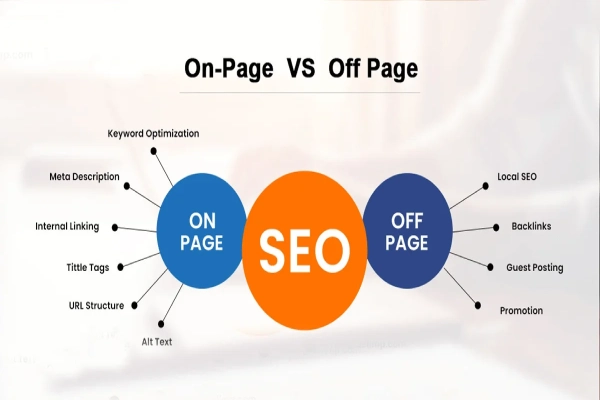
When businesses want better rankings on Google, they often hear two common terms: on-page SEO and off-page SEO. At AM Digitalz, we always explain that both are important because one improves your website from the inside, while the other builds your authority from the outside. Understanding On-Page SEO vs Off-Page SEO helps you create a stronger search engine strategy.
What Is On-Page SEO?
On-page SEO means optimizing the parts of your website that you can directly control. This includes your content, headings, images, URLs, internal links, page speed, mobile design, meta titles, and descriptions.
The goal of on-page SEO is to make your website easy for both users and search engines to understand. When your pages are properly optimized, Google can better understand what your content is about and show it to the right audience.
What Is Off-Page SEO?
Off-page SEO means improving your website’s reputation outside your own website. This usually includes backlinks, brand mentions, guest posts, local citations, social signals, and online reviews.
The main goal of off-page SEO is to build trust and authority. When other trusted websites link to your site, it gives search engines a signal that your website is reliable and valuable.
Main Difference Between On-Page SEO and Off-Page SEO
The main difference is control. On-page SEO happens on your own website, while off-page SEO happens outside your website.
With on-page SEO, you can edit content, improve speed, add internal links, optimize images, and fix technical issues. With off-page SEO, you work on building trust through backlinks, reviews, mentions, and relationships with other websites.
This is why understanding On-Page SEO vs Off-Page SEO is important before planning any SEO campaign.
Why On-Page SEO Matters
On-page SEO builds the foundation of your website. Even if you get backlinks, your website may not rank well if the content is weak, the pages are slow, or the headings are not clear.
Good on-page SEO helps improve user experience. Visitors can understand your message, navigate your website easily, and take action faster.
Important on-page SEO elements include:
Meta title and meta description
Proper heading structure
Keyword placement
Internal linking
Image optimization
Mobile-friendly design
Fast loading speed
Clean URL structure
High-quality content
If these elements are not handled properly, your website may struggle to rank even with a strong backlink strategy.
Why Off-Page SEO Matters
Off-page SEO helps search engines see your website as trustworthy. If other websites mention your brand or link to your pages, it shows that your website has value.
Backlinks are one of the most important parts of off-page SEO, but quality matters more than quantity. A few links from trusted and relevant websites can be more powerful than many low-quality links.
Off-page SEO also includes business listings, Google Business Profile optimization, customer reviews, guest posting, and social media visibility.
When comparing On-Page SEO vs Off-Page SEO, on-page SEO improves your website quality, while off-page SEO improves your website authority.
Which One Should You Do First?
You should start with on-page SEO first. Before building backlinks or promoting your website, make sure your pages are properly optimized.
If your website has poor content, slow load times, broken pages, or weak structure, off-page efforts may not yield the best results. Once your website is strong from the inside, you can move toward off-page SEO to build authority.
A strong SEO strategy usually follows this order:
First, fix technical and on-page issues.
Then publish helpful content.
After that, build backlinks and online authority.
This approach gives better long-term results.
Can You Rank With Only On-Page SEO?
In low-competition niches, good on-page SEO can sometimes be enough to rank. If the keyword is not very competitive and your content is helpful, Google may rank your page without many backlinks.
However, in competitive industries such as digital marketing, law, real estate, healthcare, finance, and e-commerce, off-page SEO is usually necessary as well.
That is why On-Page SEO vs Off-Page SEO should not be seen as a fight between two options. Both work together.
Can You Rank With Only Off-Page SEO?
Off-page SEO alone is not enough if your website has poor content or technical problems. Backlinks may bring authority, but they cannot fully fix a weak website experience.
If users visit your page and leave quickly because the content is not useful, your rankings may not stay strong for long.
This is why your website must have clear content, fast loading speed, easy navigation, and strong calls to action before you focus heavily on link building.
Common On-Page SEO Mistakes
Many websites fail because they ignore basic on-page SEO. Some common mistakes include using weak titles, missing meta descriptions, duplicate content, large images, slow pages, poor mobile design, and no internal links.
Another mistake is stuffing keywords unnaturally. Keywords should be used in a natural way that helps readers understand the topic.
Common Off-Page SEO Mistakes
The biggest off-page SEO mistake is building low-quality backlinks. Spammy links can damage your website instead of helping it.
Some businesses also focus only on backlinks and ignore reviews, brand reputation, local listings, and content promotion.
Good off-page SEO should look natural, relevant, and trustworthy.
Which Is More Important?
Both are important, but on-page SEO should come first. Think of your website like a shop. On-page SEO is the shop’s layout, products, signs, and customer experience. Off-page SEO is what people say about your shop outside.
If your shop is messy, outside promotion will not help much. But if your shop is well organized and people also recommend it, your chances of success become much higher.
This makes On-Page SEO vs Off-Page SEO a balance, not a competition.
Conclusion
Final Thoughts
SEO works best when your website is strong from the inside and trusted from the outside. On-page SEO helps Google understand your content, while off-page SEO helps build authority and credibility.
If you are starting SEO for your business, focus first on your website content, structure, speed, and user experience. After that, work on backlinks, reviews, mentions, and brand visibility.
At AM Digitalz, we believe a smart SEO strategy should combine both methods. By understanding On-Page SEO vs Off-Page SEO, you can build a stronger SEO plan that improves rankings, traffic, and long-term online growth.